CONTACT
Principle of Coater
What is Sputtering?・Principle
A thin film is deposited onto a material surface in a vacuum environment without the use of chemicals, unlike plating processes. (In semiconductor manufacturing, this is referred to as a Dry Process, in contrast to a Wet Process.)
Principle
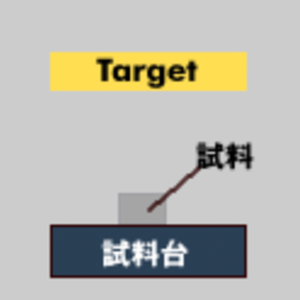
- Place the sample to be coated close to the coating material (target).
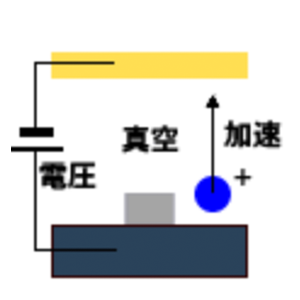
- Create a vacuum environment and apply a voltage between the sample and the target.
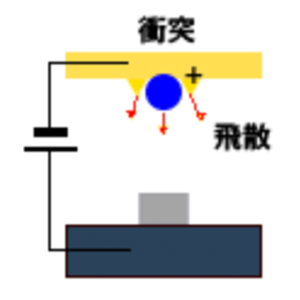
- Electrons and ions move at high speed, and the ions collide with the target. The high-speed electrons and ions also collide with gas molecules, knocking electrons out of the molecules and ionizing them.
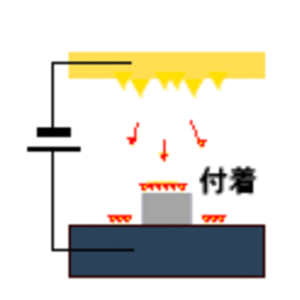
- The ions striking the target eject particles from the target surface. (Sputtering phenomenon)
- The ejected target particles travel toward the sample, adhere to its surface, and form a thin film.
What is Vacuum Deposition?・Principle
Vacuum deposition is a thin-film formation technology used to coat materials in a vacuum environment. It was commercialized earlier than sputtering and is based on a simpler and more intuitive principle.
Principle
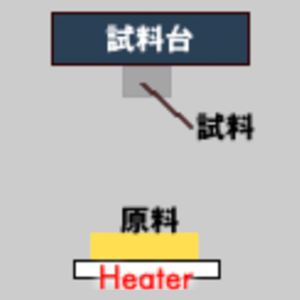
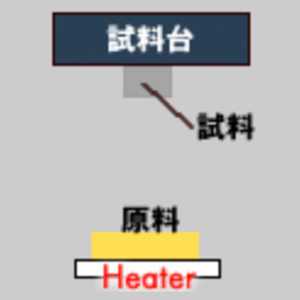
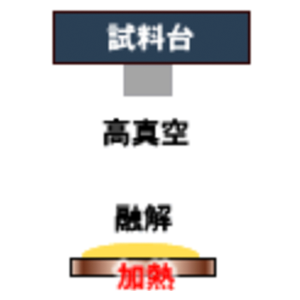
- Place the sample to be coated and the source material inside a vacuum chamber. (Unlike sputtering, a certain distance is maintained between them.)
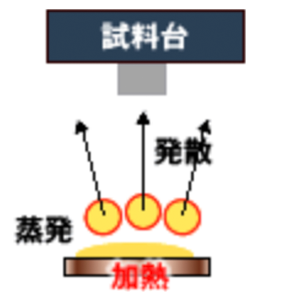
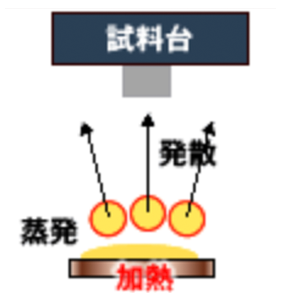
- Create a vacuum environment and heat the source material until it melts and evaporates.
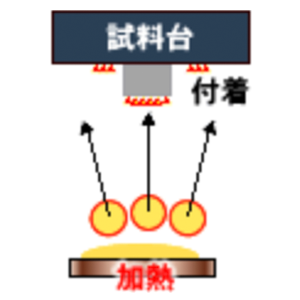
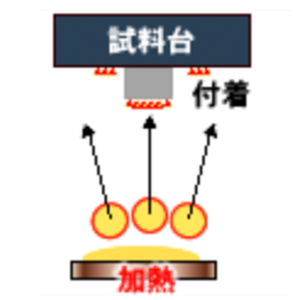
- The evaporated source material becomes vapor-phase particles, which travel to the sample surface, condense, and form a thin film.
Depending on the heating method, vacuum deposition systems may use resistance heating, electron beam heating, high-frequency induction heating, laser heating, and other methods.
A higher vacuum level than that used for sputtering is required, typically around 10-3 to 10-4 Pa, compared with several Pa for sputtering. This reduces collisions between the source vapor and residual gas molecules before reaching the sample and also minimizes the impact of residual gas molecules on the sample surface.
Features of Vacuum Deposition
The characteristics vary depending on the deposition method, but in general, vacuum deposition has the following features.
- High deposition rate, typically several times faster than sputtering.
- Relatively low particle energy, which may result in weaker adhesion. (Some systems use ion assistance to improve adhesion.)
- Simple equipment structure.
- Generally not suitable for high-melting-point source materials when using resistance heating.
- Since the evaporation source is often point-like, it may not be suitable for coating large areas.
- Film thickness can be easily controlled using a shutter or similar mechanism.
- High-purity thin films can be formed under high-vacuum conditions.
- Impurities may be introduced from the crucible or evaporation source. (This is less common in electron beam evaporation.)
- The composition of the source material may change during evaporation.
- Unlike sputtering, there is no plasma-induced damage to the sample.